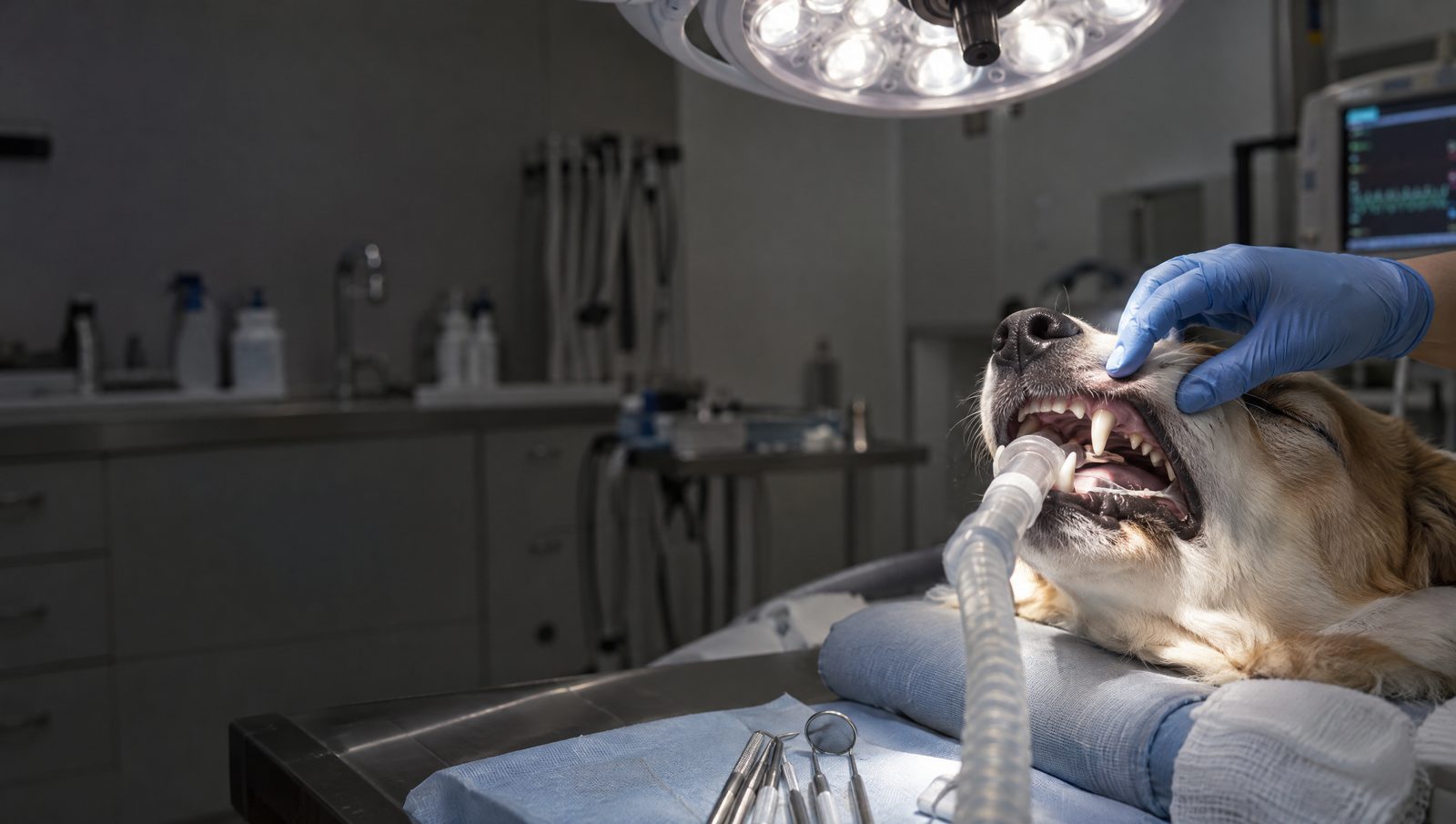
The interactive dentistry and oral surgery academy for vets and vet nurses: chart any mouth in the modified Triadan system and AVDC language, take and read diagnostic full-mouth radiographs, stage periodontal disease by attachment loss, plan every common dental block inside the patient's dose ceiling, and extract with a plan — with a checked number table behind every threshold the course teaches.
8 modules · 40 lessons · 120 gate questions · 13 branching cases · 8 interactive tools
Hours of video can tell you what periodontitis is. They cannot drill the six-site probe walk, the Triadan numbering and the root map until they run themselves at the chair.
Cat and dog local-anesthetic ceilings, per-site volumes and resorption criteria are their own. Numbers borrowed from another species or another context hurt patients.
A 4 kg cat at a bupivacaine ceiling of 1 mg/kg may receive 4 mg in total across every block site; 40% attachment loss with an F2 furcation is stage PD3. The right number at the right step is the treatment.
Every lesson, case and tool uses the same six thinking tools, so they become automatic.
Signalment and story · Conscious exam · Oral map, quadrant by quadrant · Probe and periodontal chart · Extra views. The complete exam from awake to anesthetized, in order.
Crack lines and enamel involvement · Root and periapex on radiograph · Open pulp or not · Window since injury · Next step. What to do with a broken tooth.
Radiograph: root count, curvature, sectioning map · Outline the flap · Orbit the tooth · Tension-free closure and a post-op radiograph. Plan before the first incision.
Budget first · Landmarks · Orientation · Concentration-volume math · Keep watching. Five seconds before every injection.
Film or sensor size and placement · Angle · Normalize the view set · Grade the image. Every shot, four checks.
Tell findings with pictures · Ask the owner's priorities · Line-item estimate in tiers · Keep the relationship. Findings to consented estimate.
Each branching case runs on a live anesthetic monitor with an engine-drawn strip at every step. Choose your next move; the patient answers. Scores: best move +2, acceptable +1, poor 0, harmful −2. The first case is free.
30 questions drawn from every module, 80 % to pass. Pass and you can download a verifiable certificate of completion with your study hours for your professional-development records — a certificate of completion, not accredited CE.
Module 1 is free — no card, no email. Unlock the rest when you're ready.
30-day money-back guarantee · Pay on the GlobalVetCo store: PayPal, cards, Shop Pay, Apple/Google Pay · Prices in your currency at checkout.
General-practice veterinarians, veterinary nurses and technicians, new graduates and students who do dentistry — or want to — at referral standard. No prior dentistry certification is required.
You practice on tools: a Triadan charting tool, a radiograph positioning trainer, a nerve-block planner with dose caps, an extraction planner and branching cases driven by a live vitals monitor. Every number is sourced in a visible table.
They are educational reference values. The local-anesthetic numbers come from the course's checked number tables and are ceilings, not targets. Verify every dose against a current formulary and your practice protocols.
Eight modules, 40 lessons, roughly 18–20 hours of core material, plus cases and tools at your own pace. Access terms are set at purchase.
No. It teaches recognition, planning and technique principles; surgical skills need supervised practice. Endodontics, jaw-fracture repair, tumor surgery and malocclusion correction are taught as recognition-and-referral territory.